Making a Very Plain Fold Over Leather Holster.
- muleequestrian

- Feb 24
- 3 min read
For my own personal holsters, I kind of prefer the simplest plainer style. So recently I made myself a “taco style” holster that folds and wraps around the pistol. I wanted something for my old M1917 Colt New Service revolver. I wanted something that I could knock around in the backwoods with and it didn’t need to be fancy or pretty. It needs to be utilitarian and built like a tank.
Keep in mind this is not a step by step tutorial, but it will give you an idea of how I make my holsters.
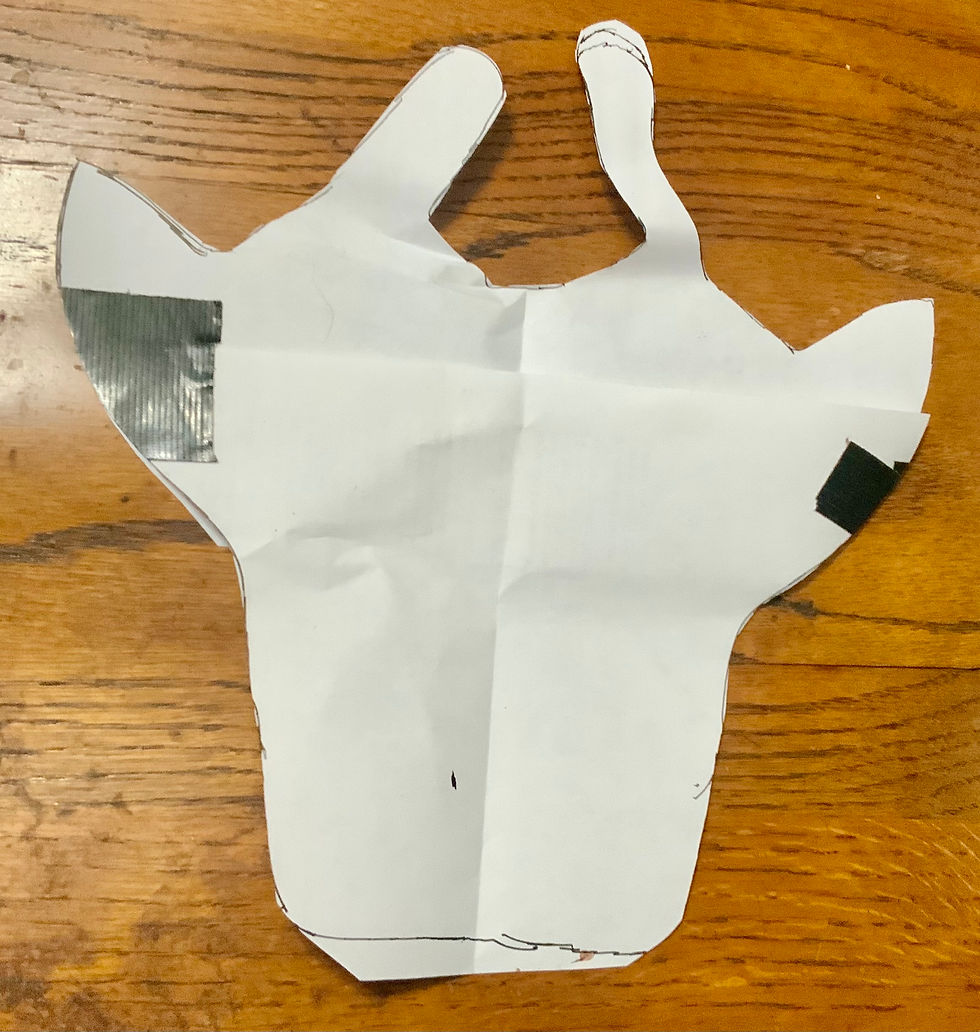
I started off with two simple sheets of paper taped together and made my pattern from this.

Ordinarily most holsters are made from 8-9 ounce vegetable tanned leather. I decided to use the next thickness up. I marked the location of the belt tab, then I glued it in place. To make it extra strong I stitched then used reinforcement rivets to make sure it wasn’t going anywhere.

This ought to give you an idea of how the holster will go together. It’s a fold over and stitched to itself “taco style”.

Next, I glued a split pig skin suede leather to the inside to make a soft liner for the revolver to rest against.

The grooves are laid out a short distance from the edge of the leather, and holes for stitching are punched in. The grooves countersink the stitches to protect them from rubbing wear.

The stitches are run with a heavy duty needle. The stitches skip every other hole to the end, then reversed back through the skipped holes to form a solid run of stitches. You can also use stitching horse with a pair of needles to run the stitches down the line. For the sake of brevity in this blog, I didn’t show how to wet the raw edges and roll them with a slicker to polish the rough edges.

Under normal circumstances I have the leather pieces dyed before stitching. In the case of this holster — I was low on dye, so I had to wait for a weekday when the leather supply shop was open. Can’t get dyes on a Sunday.

Once the holster is glued, stitched, reinforced with rivets at stress points — it gets dyed and left to dry over night.

The dried and dyed holster gets dunked in room temperature water to soak the entire holster… liner and all. I spray water displacing oil on the pistol and shove it deep into the holster and set it aside to dry for a few days.

About twice a day I check the leather for dryness and to make sure the pistol doesn’t rust. Once the holster is wet formed to the pistol, I let it drink as much leather conditioning oil as it can soak up. I apply leather oil to the holster and set it aside until it stops soaking in fast. I buff off excess oil until the leather takes on its own sheen.
I left the bottom of the holster open so dirt, etc., can fall through. I normally use my holster on my left or offside carry — and draw it across my body with my right hand. This keeps the pistol higher up on my hip and out of the way while driving a car, riding my Harley, or sitting in a chair in general.


Comments