How to make Jewelweed Salve

Updated: Aug 19
This is an old outdoorsman’s trick.
I usually make my jewel weed salve in August each year. Jewelweed can be found pretty much in most areas with moist soil in partial shade. I make a year’s supply at a time.

Jewelweed grows in bushes about 3 feet or more high and ironically it can be found growing close to poison ivy bushes.

The little orange flowers bloom in late July through August and into early September sometimes. If you touch the flowers, they often pop and shoot the seeds out over the ground. Generally speaking, these plants die off over the winter, but they come back every year.

I pick enough Jewelweed to make about 2 full cups of crushed plant material.

I put them in a blender I keep just for the purpose of making salves.

I pulp the plants until it looks like a wet hay or fresh mowed grass.

Extra virgin olive oil is the base for the salve. I’m sure you could use other types of oil as well, but I really like this stuff. I add an entire 16 ounce bottle to the plant material.

I cook this mixture in a double boiler for about an hour. It allows the oil to absorb the sap from the plants.

The other ingredients are seen here. Pure beeswax, coco butter petroleum jelly, and about a tablespoon or two of vitamin E oil to act as a preservative.
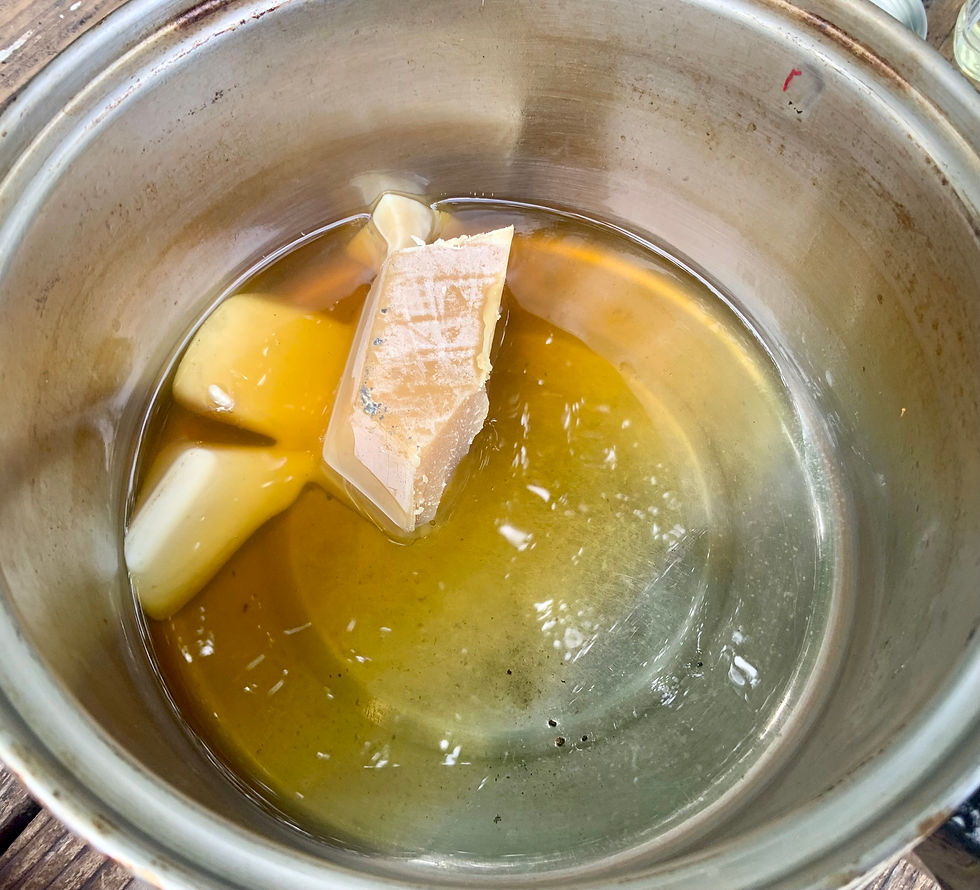
I strain off the plant material and toss it. I keep the oil. Then I begin to melt the beeswax in the double boiler. About 4 to 6 ounces will do.

Once the wax has melted, I pour the oil into the pot and stir. I turn off the burner and add the rest of the ingredients. Two ounces of the petroleum jelly, and about 2 tablespoons of vitamin E.

I pour the mixture into tins I ordered online, and wait for them to cool.

Some of the tins are 2 ounces, some are 4 ounces.
As I said before…. This is great on bee stings, mosquito bites, bug bites, and it dries up poison ivy in a hurry. In fact — I’ll let my neighbor tell you how well it works. He’s not an outdoorsman, but he occasionally gets into yellow jackets nests when working around his yard.
Comments